
Carry the incident into a complete clinical record.
Document the prehospital encounter from patient identity and history through assessment, treatment, consent, transport, clinical review, hospital notification, and signed handoff.
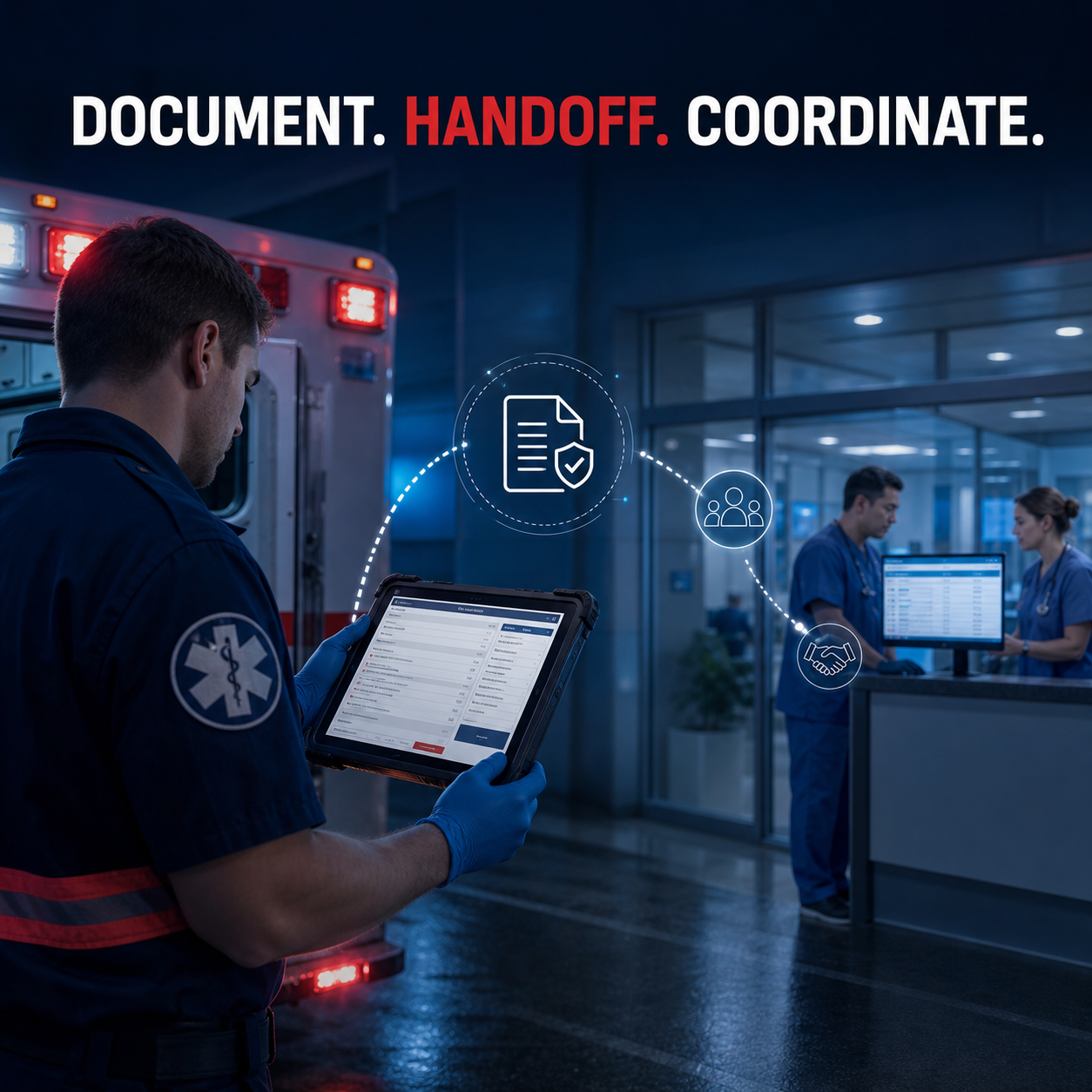
One encounter, structured from scene to receipt.
The patient-care report remains linked to the originating incident so crews do not have to rebuild operational context before documenting clinical care.
Patient and encounter
01
Capture identity, demographics, chief complaint, history, allergies, symptoms, incident relationship, and transport context.
Assessment and impression
02
Document examinations, findings, clinical impression, protocol, triage category, narrative, and configured conditional requirements.
Vitals and diagnostics
03
Record time-stamped vital signs and supported diagnostic-device observations with provenance and validation.
Medications and interventions
04
Capture medication, dose, route, response, procedures, intervention notes, outcomes, and chronology.
Consent, refusal, and signatures
05
Record decision, scope, reason, capacity assessment, patient or witness signatures, and supporting evidence.
Attachments and media
06
Add protected clinical photos, audio, video, documents, and other permitted evidence to the encounter.
Review and correction
07
Use submission validation, supervisor review, closure attention, corrections, addenda, immutable events, and version controls.
Handoff
08
Record receiving facility, recipient, condition, notes, team and recipient signatures, and transfer of responsibility.
Keep documenting when connectivity fails.
The native field application queues clinical work locally, protects it before persistence, and synchronizes on startup, resume, or restored connectivity.
- AES-256-GCM encrypted clinical outbox
- Keys held in platform secure storage
- Stable client and event identifiers to prevent duplicates
- Bounded retry for transient failures
- Conflict inspection and controlled resolution
- Failed work retained for operational review
Document in the field. Review and coordinate in the browser.
Native Android, iOS, Windows, and Mac Catalyst workflows support ambulance crews, while protected browser workspaces support clinical review and hospital operations.
Native crew ePCR
FIELD
Assessment, treatment, evidence, signatures, offline continuity, notification, and handoff from the field app.
Review workspace
CLINICAL
Completeness, conditional validation, audit, amendments, attention queues, and authorized corrections.
Receiving workflow
HOSPITAL
Advance notice, acknowledgement, preparation, arrival, patient receipt, and transfer assurance.
Clinical documentation connects to destination and receipt.
Use the ePCR as the governed clinical foundation for hospital coordination, medical control, and downstream exchange.
Destination & preparation
HOSPITAL
Coordinate the receiving facility from advance notice through receipt.
Configured care supplements
FORMS
Add governed templates for program-specific field data needs.
Health interoperability
EXCHANGE
Scope FHIR, HL7, NEMSIS, NPHIES, EHR, and national or regional exchange profiles.
Bring the medical, field, hospital, reporting, privacy, and regulatory stakeholders together.
We will turn the required care pathway into a configured release plan with explicit clinical, security, interoperability, downtime, and acceptance gates.