
Run the entire response from one coordinated platform.
Connect dispatch, live mapping, incident navigation, native field crews, electronic patient care records, receiving hospitals, offline on-device AI, configurable forms, and command oversight—without losing context between teams.

Native field apps
Offline continuity
TAK interoperability
Private on-device AI
Hospital coordination
Flexible deployment
Keep the incident connected all the way to the hospital.
The same incident, unit, patient-care, destination, and handoff context moves forward—reducing duplicate entry and disconnected status calls.
Receive
Dispatch
Navigate
Treat
Coordinate
Handoff
Improve
Every unit. Every incident. Every next action.
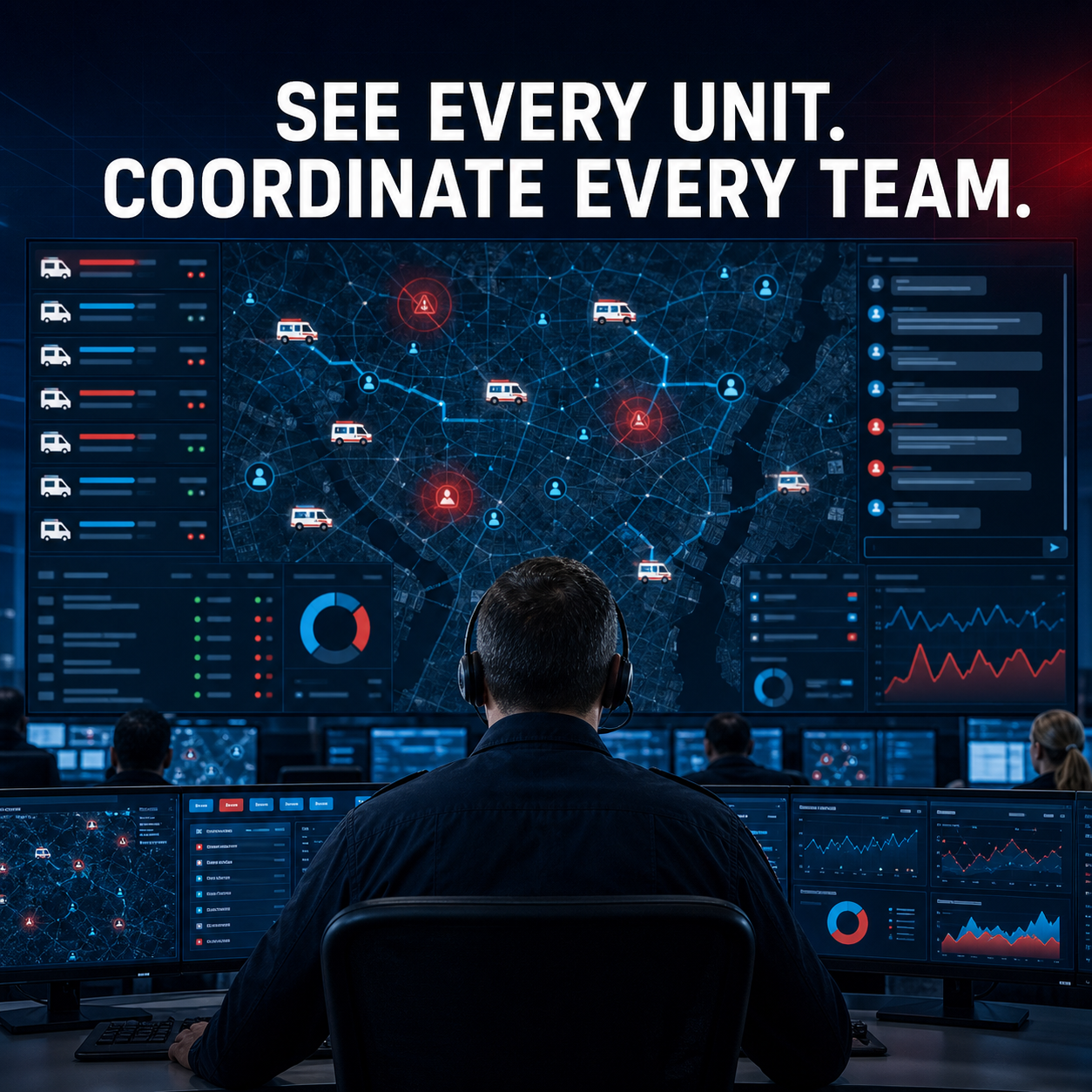
Dispatchers and crews share current incident geography, unit status, assignments, and lifecycle events. Field teams can move from an assigned incident to mapping, response status, and patient care without rebuilding the call.
- Live unit, incident, facility, hazard, and operational map layers
- Incident-coordinate handoff to supported navigation applications
- Native iOS, Android, and Windows mapping with connected Esri/ArcGIS services and disconnected offline packages
- Offline raster, vector, MBTiles, GeoPackage, PMTiles, VTPK, and TPKX workflows
- Device GPS and supported Bluetooth GNSS positioning
- Role-aware realtime updates and durable audit history
M8P1H1
Illustrative interface · incident to facility
Coordinate with ATAK, iTAK, WinTAK, and other TAK-enabled teams.
The platform connects to an agency-operated TAK Server so web command users and native Android, iOS, and Windows users can work alongside the broader TAK ecosystem without creating a separate operational picture.
- Bidirectional position location information (PLI) and blue-force/team tracking
- Incident missions, Cursor on Target markers, priorities, status, and location context
- Incident-linked GeoChat and TAK emergency-alert markers
- Operational zones and geofencing through deployment-configured map and TAK workflows
- mTLS, enrolled service identity, role-aware access, monitoring, and controlled data egress
Fourteen connected capabilities. One implementation.
Deploy the modules your service needs while preserving one operational and clinical path from dispatch through hospital receipt.
Call intake & CAD
01 / DISPATCH
Incidents, resources, assignments, priorities, statuses, notes, files, and realtime operations.
Mapping & incident navigation
02 / MAP
Native iOS, Android, and Windows maps with connected Esri services, offline packages, GPS/GNSS, and navigation-app handoff.
Native crew operations
03 / FIELD
Android, iOS, Windows, and Mac Catalyst workflows with resilient synchronization.
Patient care records
04 / ePCR
Patient history, assessment, vitals, medications, interventions, consent, signatures, and review.
Hospital coordination
05 / HOSPITAL
Facility readiness, destination support, advance notice, preparation, arrival, and receipt.
Configurable ad-hoc forms
06 / FORMS
Schema-driven forms, conditional logic, calculations, media, signatures, barcodes, and location.
Documents, media & live video
07 / CONTENT
PDF, EPUB and Office-content viewing, rich text authoring, multi-view workspaces, and public-safety video streams.
Operational records
08 / RECORDS
Carry incident context into durable cases and reports with permissions, files, and audit logging.
Decision support & ETA
09 / SUPPORT
Explainable unit scoring, ETA models, and clearly labelled fallback behavior.
Analytics & oversight
10 / COMMAND
Demand, resource positions, trends, hotspots, response measures, quality indicators, and exports.
TAK interoperability
11 / TAK
TAK Server, ATAK, iTAK, WinTAK, PLI/BFT, CoT markers, GeoChat, emergencies, zones, and team coordination.
Offline, on-device AI
12 / LOCAL AI
Private document import, cited search, grounded questions, summaries, extractive fallback, and optional local Windows generation.
FDW & Nango integration mesh
13 / DATA MESH
Governed PostgreSQL, PostGIS, Steampipe, OGC, Esri, and SaaS data access with private caches and controlled publication.
Integration & interoperability
14 / ECOSYSTEM
APIs, webhooks, GIS, identity, devices, health exchange, NG911, TAK, and partner systems.
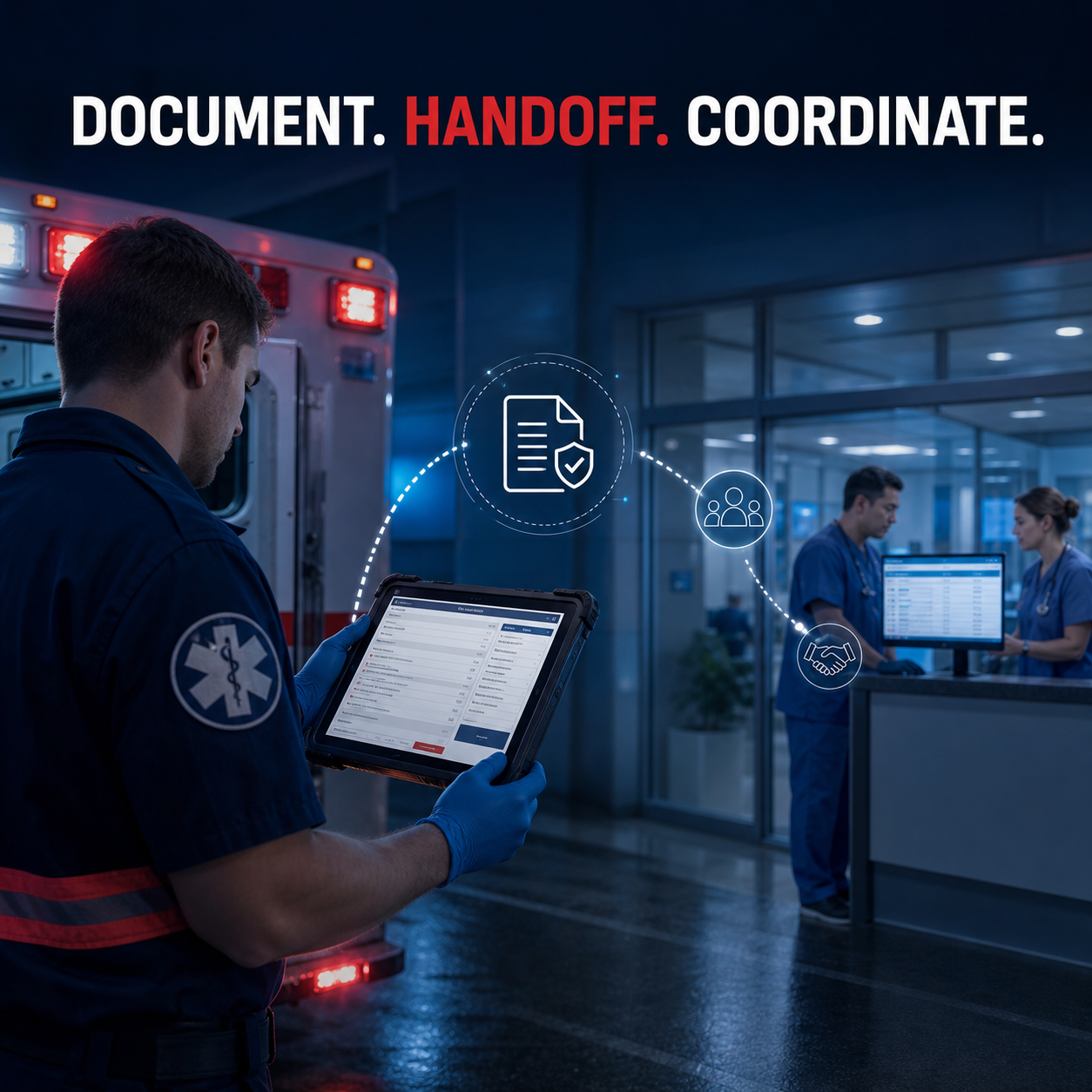
Patient care and hospital coordination are first-class workflows.
The native field client and browser workspaces support the care pathway—not just dispatch and fleet status. Crews can document care, work through connectivity loss, coordinate a destination, and deliver an auditable handoff.
- Patient identity, history, allergies, symptoms, assessment, impression, protocol, and triage
- Vitals, medications, interventions, diagnostics, media, consent or refusal, and signatures
- Encrypted offline clinical queue with retry, deduplication, and conflict review
- Hospital readiness, capabilities, capacity, ETA, notification, preparation, and receipt lifecycle
- Clinical review, corrections, addenda, version control, and protected audit trails
Software is only one part of an operational system.
We work with your implementation partner to design, configure, integrate, validate, train, launch, and support the complete deployment.
One accountable program from workflow design to go-live.
Built around actual call types, unit models, clinical governance, geography, facilities, roles, language, infrastructure, and partner systems.
Map the operation
01 / DISCOVER
Document call flows, dispatch policy, clinical pathways, resource types, forms, integrations, security, and success measures.
Fit the market
02 / CONFIGURE
Set language, terminology, roles, protocols, forms, maps, notifications, data residency, and deployment profile.
Connect the ecosystem
03 / INTEGRATE
Implement validated interfaces for GIS, identity, diagnostics, hospitals, EHRs, reporting, and partner workflows.
Launch with support
04 / OPERATE
Train users, validate clinical and downtime behavior, transition data, monitor service, and manage releases.
Response visibility
Clinical completeness
Hospital readiness
Management insight
Your infrastructure. Your data. Your operating model.
Choose the deployment profile that fits sovereignty, security, scale, procurement, and partner support requirements.
Designed for operational control.
Managed cloud
A configured managed deployment with monitoring, backups, and support defined for the engagement.
Private cloud
Operate in a customer or partner cloud with regional hosting and agreed operational responsibilities.
On premises
Deploy inside customer-controlled infrastructure where policy, connectivity, or sovereignty requires it.
Sell it your way.
PARTNER-LED GROWTH
Systems integrators, ambulance manufacturers, rugged-device vendors, telecom providers, and healthcare software companies can package the platform with their services and market access.
- Referral and authorized resale
- Implementation and managed service
- Co-branded or white-label edition
- Territory or vertical source licensing
Add recurring software to the solution you already sell.
Create a connected-ambulance, dispatch modernization, hospital transport, or sovereign EMS offer under our brand, your brand, or a jointly delivered model.
Ambulance Platform Licensing
Source code license, annual subscription, native apps, and professional services for agencies and implementation partners.
Bring us the workflow, fleet, clinical model, and market.
A focused workshop produces a module plan, care-pathway map, integration plan, delivery model, and pilot path.