
Support the decision. Show the reasoning.
Compare candidate resources, estimate arrival ranges, and surface configured decision support while keeping dispatchers accountable for the final action.
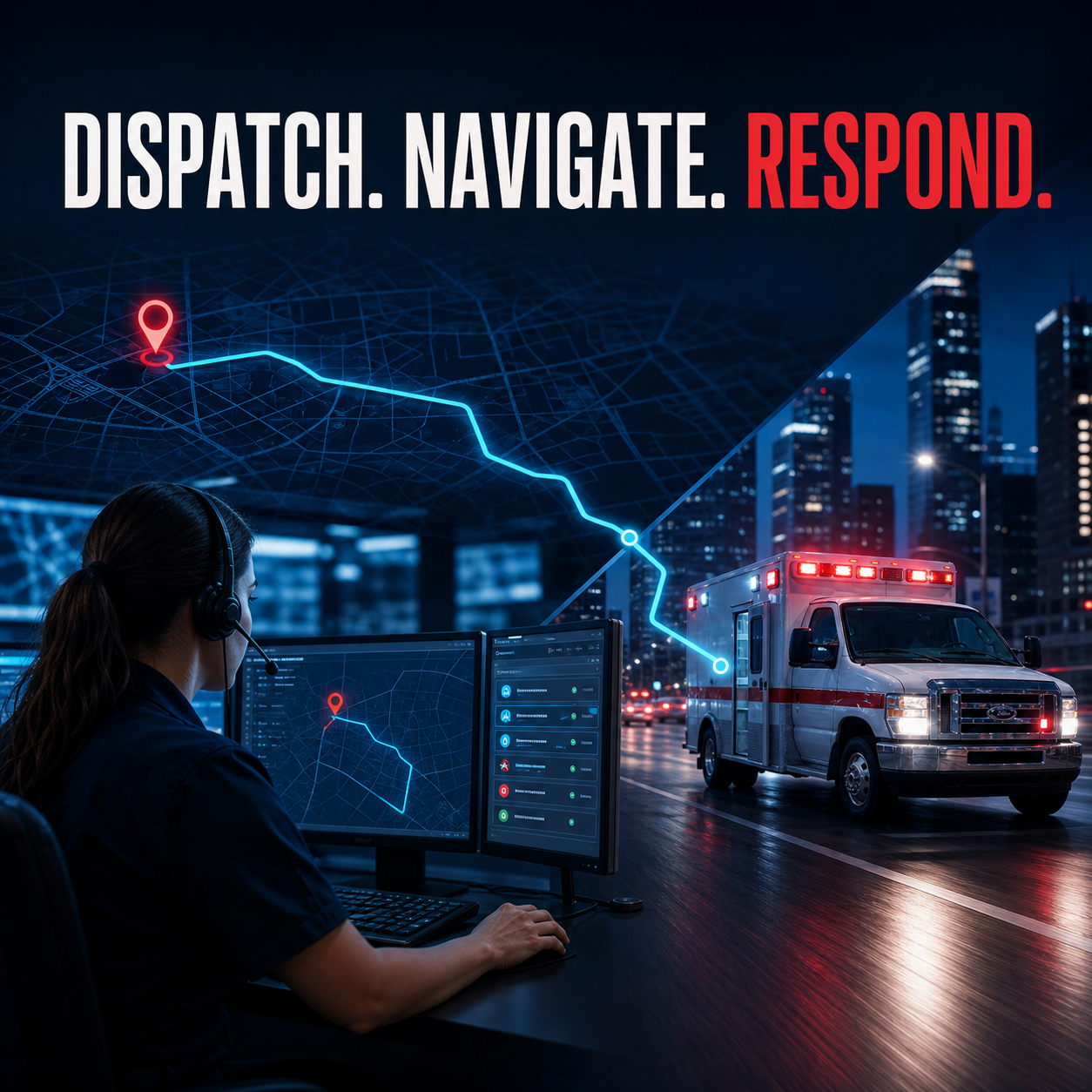
Useful guidance without invented certainty.
Responses label whether they came from a trained model, a rule set, a heuristic fallback, or an external AI provider.
Candidate scoring
01
Score available resources using configured operational factors rather than a hidden autonomous action.
ETA quantiles
02
Use the ETA model pathway for p50 and p90 predictions when a trained accepted model is available.
Labelled fallback
03
Return an explicit heuristic result when model inputs or model artifacts are unavailable.
Provider-backed analysis
04
Optionally use configured OpenRouter-backed analysis, summarization, decision support, or risk assessment with explicit provider failure behavior.
Unavailable inputs
05
Disclose missing weather, traffic, model, or provider data rather than silently fabricating it.
Human authority
06
Keep recommendations in the dispatcher workflow with visible rationale and user-controlled action.
Every recommendation should answer: “why this?”
The operating team needs to know which method produced the result, what data it used, what was missing, and when to disregard it.
Method
Inputs
Uncertainty
Authority
Validate the model in the market and operating environment.
A responsible deployment defines training data, drift, bias, fallback, monitoring, clinical boundary, user authority, and incident response before relying on a recommendation.
- Document intended use and prohibited use
- Measure model and fallback performance separately
- Monitor input availability and change
- Record user action and overrides
- Revalidate after material workflow or data changes
Not autonomous care or dispatch.
DECISION-SUPPORT BOUNDARY
The platform can assist operational decisions. It does not claim to replace trained dispatchers, clinicians, medical direction, policy, or local authority.
Offline document intelligence
PRIVATE • ON-DEVICE
The native application also provides a separate local document-analysis workspace for cited search, grounded questions, and summaries without a cloud-model dependency.
Analyze operational references locally.
This is distinct from dispatch recommendations: documents remain in the app, results stay grounded in retrieved passages, and Windows or Android users can continue while disconnected.
Bring historical scenarios and the rules your dispatchers actually use.
We will compare model, rule, and fallback behavior against an agreed review process.