
Give the receiving hospital time to prepare.
Connect field crews and hospital teams through facility readiness, destination support, advance notification, preparation, arrival, handoff, patient receipt, diversion, and escalation workflows.
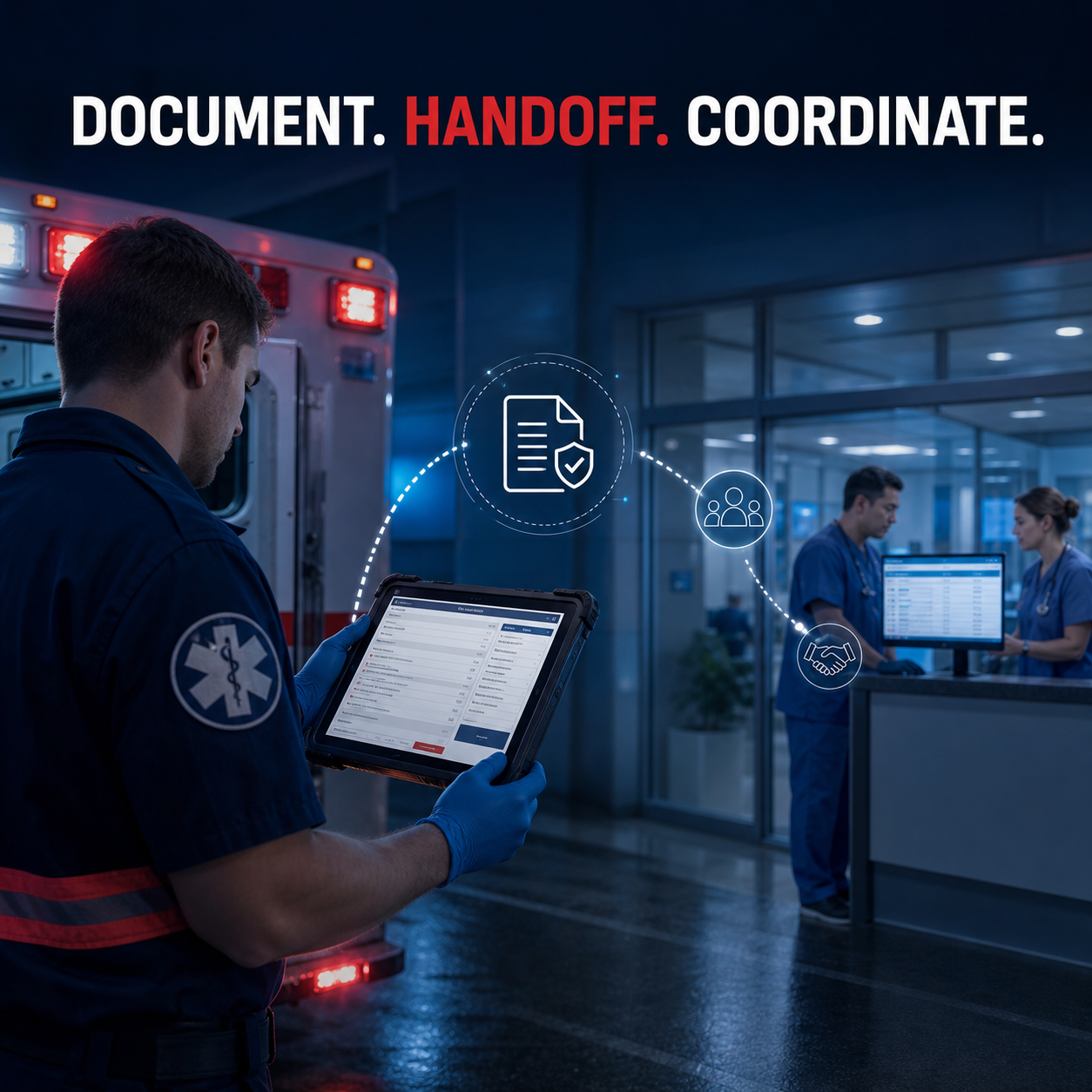
Coordinate the destination—not just the address.
Crews need a clinically appropriate destination and proof that the receiving workflow is progressing. Hospitals need concise, governed information with clear ownership and timing.
Facility readiness
01
Maintain operational readiness, capability, capacity, service availability, and notes for participating facilities.
Destination advisory
02
Compare configured destination signals and ETA while keeping the clinical destination decision with authorized personnel.
Advance notification
03
Send incident- and ePCR-linked pre-arrival information with severity, classification, ETA, and minimum-necessary clinical context.
Hospital preparation
04
Track acknowledgement, accepted preparation ownership, care-area assignment, readiness tasks, and escalation attention.
Arrival and patient receipt
05
Record arrival, acceptance, transfer of responsibility, receiving personnel, receipt assurance, and unresolved handoff items.
Diversion and major incidents
06
Coordinate diversion, cancellation, capacity pressure, multi-hospital awareness, unnotified patients, and major-incident load.
The ambulance sees the lifecycle. The hospital sees the queue.
Field crews can follow acknowledgement and preparation without revealing unnecessary hospital detail. Receiving teams can work an ETA-ordered queue, update readiness, prepare resources, and complete patient receipt.
- Sender-side notification and receipt assurance
- ETA-ordered hospital reception queue
- Role-scoped clinical access and read auditing
- Realtime refresh with polling fallback
- Version and idempotency safeguards for repeated commands
Hospital coordination begins before transport.
Patient care, destination, notification, preparation, and handoff remain linked to the originating incident.
Patient care records
ePCR
Capture the clinical encounter that supports destination and handoff.
Mapping & navigation
ROUTE
Carry incident and destination coordinates into the crew workflow.
Health-system integration
EXCHANGE
Connect configured hospital, EHR, FHIR, and partner interfaces.
Bring your hospitals, capabilities, escalation rules, and handoff policy.
We will turn them into a configured coordination pathway with explicit privacy, safety, interoperability, and acceptance gates.